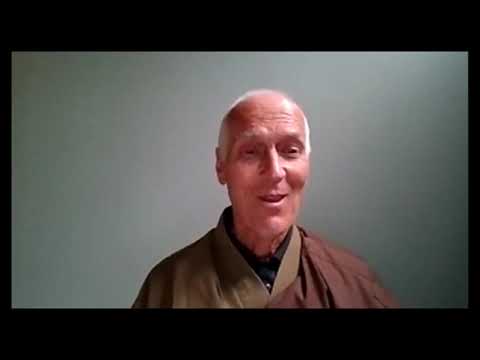
Michael Daly — Deepening Practice through Sesshin
Sunday, February 22, 2026
Big laptop belongs to Buddha. Yeah, it's a fancy little thing on top of it. We've got a button for it. Here, I'm going to angle it down. It's on? It's ready to go? Yeah, let's do it.
So yeah, we got a new laptop so that whoever does Sunday service, the Zoom folks can log in. There's instructions, there's a login, and you don't have to use your own equipment, which is nice. And then whatever else we need. It's nice to have a bigger screen to see our visiting folks. It would definitely be useful when we have a speaker that's virtual, and we'll continue to put it here. We might put a blanket over that. Hopefully the audio works. Do we have anybody else regularly? Not regularly. It varies. We usually don't have more than three or four. That's been a concern. Getting over the hill is hard. It is set up for the year. Each year we renew the meeting and the ID doesn't change, so you can log in and we just click in. Please join if you can't make it over.
So yeah, my name is Michael. I'm going to back up from this a little bit. How this came to be is that very recently there was a sesshin called Denkoryu, which is this celebration of Buddha's enlightenment. And it's one of four major sesshin that's done at the Jokoji Zen Center, which is up in the Santa Cruz Mountains. Four of us here — practitioners here at the Santa Barbara Zen Center — attended: Anton, who's our board president, David, myself, and Aaron. When we came back, Eliza was very nice to offer up an idea, because we didn't have a speaker for a couple of weekends. She said, hey, maybe we can have a panel on sesshin. And I think we all said, that sounds great, let's do it. And then meanwhile, Anton emails me and says, hey, can I get your picture and a bio from you for the website so we make it official? And I was like, all right, what happened to the panel? I didn't know this was me. And then it just kind of morphed from there. I was like, okay, well, maybe I'll do a little bit of an origin story on sesshin, a little background on sesshin, and then we'll do the panel and talk about our own personal experience. So that's what I'm going to do, if you don't mind.
And in the meantime, I have to say that while all of this was happening, my wife was telling all my friends that I was away on a trip to a Zen center. They had no idea. Of course, we don't go screaming from the mountaintops that we're Buddhists, right? We're practicing. So then I get on a call with them and they're like, what is this retreat thing you're doing? So I explained to all of them what sesshin was. And what's even funnier is the photo I used for the website was one my dear friend Emily took. She's like, where's the photo credit? So it all came full circle. So if they're watching, hello, Emily — you get a little credit for the photo — and Casey and Matt and Jordan, my dear friends, who will do their own sesshin sometime soon. We all love getting out in nature. So, all right.
I started last night, actually. I went ahead and did a little calligraphy. That is not Geroux. I don't know if I was well taught, but I was taught by Geroux, so I gave it my best crack. So these are the two symbols that essentially mean sesshin. It's a very artsy version of it. It's much better done in actual writing. But the translation is: sesshin is a Japanese term, and the translation is "touching the heart-mind." And what sesshin essentially is — it always reminds me of the word "session" — it kind of is a big, long session of intensive Zen meditation. It's a cornerstone practice of Zen Buddhism.
So I'm going to talk about the origins and early development of it, the Chinese roots, the Japanese adaptation. It mirrors the story of Zen, from Chan to Zen, and just the history of it. Sesshin has been with Zen since very early on. I'll talk about the modern transformation, the modernization, how it came to the West. A little bit about Soto practice. I think I'll throw a little Rinzai in there as well as a comparison. The different roles in sesshin — I'm not going to get to those in depth. I have a lot of information here if you want to look at it afterward. I'll try to hit the bullet points, and then some case studies of people's contemporary experiences in sesshin. But I think mostly we want to hear from us about our recent experience.
Just real quick: I've only been to two week-long sesshin. I've been to one that was about three days long — more of a bridge version — and that was the first one I did. I'm glad I started there, because six or seven days of just sitting is quite a lot, and it's nice to warm up to that. If you're thinking about doing this, it's nice to start maybe with a weekender. But a full sesshin is typically a week long here in the West these days, and it's pretty intensive. You sit, you eat, you use the restroom, you walk around. That's about it. You're not on your phone. You're not reading. You're not even talking, typically. Noble silence doesn't mean people don't try to talk or aren't tempted, right? You're supposed to bow and take things aside and speak quietly, but even that is kind of a no-no.
So, just to go into the origins: sesshin emerged in the Japanese Zen monasteries during the medieval period. The origins of sesshin are difficult to pinpoint, but they say it grew out of the monastic training system when Zen was transmitted from China to Japan in the 12th or 13th century. Early Zen masters like Dogen, who is the founder of the Soto school, and Eisai — if I'm saying that wrong, correct me — who is the founder of Rinzai, they emphasized these intensive meditation periods as being essential for the way.
In the Chinese tradition of Chan, it goes back to the same monastic training system back in the early Tang and Song dynasties, roughly from the 7th to the 13th centuries. These Chinese Chan monasteries established long meditation periods called jingqi, meaning "intensive period." This was typically held during the winter months, which makes perfect sense. I immediately pictured this: all the agricultural work has ceased, it's maybe snowing or the weather's terrible, and what are they going to do but just sit? So they would devote themselves fully to practice during the winter months. They had developed these seasonal retreats very early on. They had summer and winter training periods that monastics called jiecha and jiedang, and that became the tradition.
When this was brought over to Japan around the 12th century — to both the Rinzai and Soto schools in the 1200s — it was adapted a bit to monastic culture in Japan. I'm bringing this up because we're a Soto lineage Japanese tradition here. So sesshin is actually a Japanese term, but it draws on all the Chinese concepts. Dogen was very influential in formalizing some structure. He had a manual called Eihei Shingi, which means "pure standards for the Zen community," and he had exact protocols for monastic life, including around these intensive meditation periods. But he emphasized the term byoji-dokkan, meaning "continuous practice penetrating all activities," which means sesshin wasn't separate from daily practice. It wasn't a thing you went off to do — it was just part of their practice, and it was an intensification of the ceaseless training that was already underway. So they perhaps didn't really think of it in a dualistic sense, which makes sense — that's what the teaching is, eliminating duality. Sesshin was just part of practice, but it was a tradition that came up seasonally.
There's quite a bit more on the different periods of development that took place in the 1600s, 1700s, and 1800s, leading up to the 20th century. The overall arc is that sesshin became more codified. It did become more of a thing that had rules and styles and emphases. I think it came along in the same wave as, for example, the formalization of Japanese tea ceremony — Jiro talked a bit about that at the recent sesshin we attended. A lot of the forms that got developed during those post-medieval years up into the 17th and 18th centuries all came together, and sesshin was no different. Roles for different participants became formalized, schedules became formalized, and so on. There were also efforts to make it relevant to modern life, which I think is still being done today. There are liberties taken, to some degree, to make it palatable for folks.
But it really did, early on in these transformations in the 1800s and 1900s, try to make sesshin more accessible to lay people — less a monastic tradition and more available to lay practitioners like me, which is nice, because I've had a great experience and I'm looking forward to doing another one.
There's mention of Harada Daun Sogaku, who lived from 1870 to around 1960, and he was particularly innovative and influential in bridging the Soto and Rinzai approaches and making sesshin more accessible to lay people. That influence later came to the West.
So I'll try to get through this so we can get to talking about our own experience. The most well-known sesshin is Rohatsu — a week-long retreat in early December that commemorates Buddha's enlightenment. A typical sesshin these days involves multiple days of intensive zazen. It's usually five to seven days. You could be sitting up to twelve hours a day, maybe a little less, maybe a little more. Historically and traditionally, you get minimal sleep and very simple meals. That's not always the case — I've gotten a good eight hours of sleep. But you may not sleep well. Maybe that's where the "minimal sleep" reputation comes in, because it's pretty intense. It can be rather hard on the mind and body. You're sitting a lot. You're sitting with yourself a lot, and your body is doing a lot of work. Your back, for instance — you want to be comfortable when you're sitting, but it's still just a lot of intensive sitting. I found it exhausting. So I slept really well. That was me, though. That's not everybody.
There's reduced conversation or complete silence, as I was saying earlier. And then there are different elements, like dokusan, which is a one-on-one sitting with a teacher. At our most recent retreat, it was really nice — we were kind of outnumbered by teachers. There were maybe five teachers, four of them there. There were a lot of teachers, and there were dokusan opportunities with almost every one of them, which was really cool. In the Soto tradition, dokusan is often just an opportunity for the teacher to ask about your practice and let it go from there. In the Rinzai tradition, a lot of koan work gets done during sesshin. They're very — you tell me if I'm wrong, because I know you have a Rinzai background — the sesshin can be very koan-intensive, where you're working with different prompts and koans. That's a big part of dokusan as well: receiving those koans or working through them.
In the Soto tradition, the focus is very much shikantaza, which means "just sitting." You're not dealing with a particular object. It's just like sitting here — just more of it. You're not dealing with koans or goal-seeking. Dogen taught that zazen itself is enlightenment and not a means to it. So it has this quality of just, you know, you're just sitting. And I think when people hear this from outside the practice, they're like, how do you just sit and look at a wall for hours a day for a week on end? I think that's a really short-sighted perception of what it is. It can be quite eye-opening. Just the process of that much sitting with yourself and nothing else — it's hard to put into words.
These sesshin emphasize sustained, wholehearted presence without much agenda. There will be dharma talks given each day. At ours, there was usually a dharma talk once a day, which is a little more talkative than some sesshin. But they can often be a lot more rigorous. Rohatsu in particular is especially rigorous. They really frown upon speaking.
I'm running about out of time here. So I'll go over some quick roles and elements of sesshin and then we can get to this panel.
The Ino is like the chant leader and helps make sure things are running well. The Tenzo — very important — is the head cook. They'll cook these meals for six days on end. We had a really awesome Tenzo. Very good. It's quite a job. And doing some research on it, they say great Tenzos are often remembered for decades, and that their Zen practice is in the kitchen. Everything they're doing is their zazen as they're preparing meals.
There are also Fukutens. I happened to be a Fukuten at the most recent one because the Tenzo needed help, and I came up with my own moniker: "Where were you, Fukuten, five minutes ago?" I was always late getting there to help. Yeah, that was between me and the Tenzo.
The Doan is the bell ringer. The Han is the wooden board struck on the side of the building to signal everyone. They use the Han to call everyone into the zendo traditionally, which gets very well used. For me, I'm not always looking at my watch — I just listen for the Han and know to go to the zendo. The Shika is like the guest manager. The Tanto is the head of practice.
And then mealtimes — this could be a whole other panel. We do mealtimes with oryoki. It's a ritualistic, mindful practice of eating with nested bowls. There are lots of forms, chants, and a kind of family-style eating. It's like a ballet at the table. I love oryoki. I'm trying to bring it into my own home and my wife's receptive for the weekends. It's quite an amazing experience. I like how it helps me slow down. I'm very thoughtful. I taste things more. So oryoki is a whole experience in and of itself within the sesshin.
I had some examples of stories from Philip Kapleau and Shunryu Suzuki and their experiences integrating sesshin into their practice. I think I'm going to pass over those. If you want to read them, I'll have this here afterward. But one I'll bring up is Suzuki's, which I kind of like: "You're all perfect just as you are. And you could use a little improvement." It's a paradox that captures the Soto spirit. Sesshin wasn't about gaining something you lack, but fully realizing what you already are. I think that sums it up really nicely. You're not there to gain anything, or to attain something, or to say you did it. What it does is put you in touch with yourself in a way that is hard to do with all the noise we have in our daily life.
And so a big question I always leave with — and I've gotten closer to this now with practice — is: how do I take this very contained experience, with no cars, no phone, no sounds, no honking horns or beeping backup alerts, no people and their dogs, how do I take what I've gotten out of that into my daily practice? And I'm still finding that there is opportunity in our daily lives to practice this kind of intensive zazen. But it is harder, because there are so many externalities and variables that take us away from it. Like needing to go to work. Or helping my son get dressed or something.
So I'll leave it at that and I want to stop talking. Maybe I'll just lead a little more by example. I'll just say, let's talk about our experience at this most recent sesshin, or any sesshin experience any of you have had. I think I said what it was like for me. It's a very good experience and I try to do it whenever I possibly can. It's a time commitment, for sure. But I want to start with Aaron. So why are you guys looking at me?
Aaron: Yeah, well, the original intent was to get some more voices in here. Sure. Well, first I want to thank you, because I learned a lot from what you put together. That's not something I had researched, and this happened very last minute for me — all of this was thrown together in under two weeks. So I just showed up and smiled every time I asked for more information. And someone just said, dear one, just come. So I really was thrown in, as they kept saying, in the deep end. Although I had had quite a bit of experience with other long forms of meditation in two other lineages in particular — one more from an Indian yoga tradition and another more on the Tibetan edge of Buddhism. So I'm definitely still processing.
It was interesting to notice today — and I hadn't really thought about this, but it didn't surprise me — that I got a bad head cold two days after I got back. Also didn't surprise me. So I wasn't practicing regularly in the morning like I normally do. I was just tired and wiped out. When I kind of came out of that, which was only a few days ago, I recognized just that human aspect of it — like, whoa, getting back into the practice was not like wrestling a bear, but it certainly might have been a little easier had I just continued that after I got home.
But today when I was practicing, one of the things I noticed — and I definitely attribute this to doing the sesshin — is that the structures we set up, everything from the bell to the bowing, all of the rituals that we use, as you practice those more and at times go into a deep dive with them, they take you and lock you into a space pretty fast. And the quality of my practice today — it may not be this way every time — but the quality of my practice today, I would notice: wow, there's a presence here that kind of echoes what my presence was there. So that is certainly a benefit.
It's funny that you bring up the oryoki and how much you loved it. I very much struggled with that. Had I been there for a month, I think my system would have adjusted, but I had a very different experience. I don't eat that way. I felt rushed the whole time. The food was delicious, but there were some foods that didn't agree with me. And at first no one was telling me little tips — like, maybe I could skip something. It was just, you have to eat everything in your bowl. And I was like, oh, this is really messing me up. I was eating at different times than I normally eat. So it really physically threw me off, if I'm honest. However, by the end of the sesshin, I noticed how my body was starting to regulate into the rhythms of it. And like you know, as practice is teaching me, there are adaptations we're making so that people living now, in this day and age, can practice in a way where you're not creating more suffering for yourself. But all of that happened toward the end of the week.
I want to be mindful about what I say about this experience because I'm still processing it. The practice isn't just the sitting, and everyone knows that, but I don't think you really know that until you get there. As I was engaging with it, you're in and out of practice all the time — which is really just asking: how present am I while I'm there? Which is how we are throughout our day. Could I walk down the path more mindfully on my way to the zendo? What am I thinking about in the shower? Could I just be present with the water? Am I breathing? The practice can really be taken anywhere. And just like in life, I was coming in and out of that practice all the time. Oh, I'm also rushing to the zendo. And then I would catch myself. Why are you rushing? There's no need to rush. But how that's been trained into me from the culture we're in.
So there were just lots of moments to work with that. And because you're practicing — as Michael mentioned — in community, in a tight-knit community, it was also helpful to learn from some of the teachers. One of the teachers pointed out that this practice came out of a monastic tradition. Even with the oryoki, I was talking to one of them about it and they said, you know, monks had to get through a meal really fast. So it wasn't built just upon how can we create this really mindful experience — it's also very practical, about moving people through and getting their bowls clean. That helped me relate with it in a different way.
But in this tight-knit community, you have the opportunity to be very present with yourself and with everyone else, and all that they embody as well. For me, it was an opportunity to watch my mind. And what I appreciated in myself — I'll admit this — I think it takes years of practice to get to a place where you're not going into shame or beating yourself up. It was just, oh, I'm watching my mind. Rather than labeling things and needing time to dissect and analyze them, I was just letting them be. Letting the energetics of my own experience simply move through — that's how I would put it. So it was an opportunity, and there's really no difference when you get down to it, to let myself be and let others be, and see what just emerges out of that space.
There's so much more I could say, I suppose, but I do want to allow other people to talk. And this is just unfolding very gradually.
One last thing I would say is: within our culture — and I've noticed this in other experiences I've had with these intense containers we move ourselves into together — the integration is, if not more important, then especially in our culture, something that needs support. Because in other cultures that these practices were designed within, you just kind of walk back into your tribe or into a culture that either acknowledges and respects that, or everyone around you tries to maintain a similar continuity. We're just thrown back out into this world where most of us are on our own. So I was really sitting with that question: how do I maintain, or just really stay connected with, what I experienced? Because from my own experience, it is very easy to just have it go off into the ethers.
I think there are ways for us to support its blossoming more fully. And what was really wonderful is I had an opportunity to talk with two female teachers there who are really thinking a lot about that too — how the relational space outside of that container is vital, and is part of the practice that perhaps doesn't get talked about or recognized as much. This is something I am sitting with right now in regards to my experience. Thank you.
Michael Daly: I always noticed they kind of warn you as you leave: you're in an alternative state of mind by the end of sesshin. Your wavelength is slow. And I've noticed each time I've driven away from there how slowly I'm driving, how foreign it feels. How crazy everybody else seems for the way they're driving. It takes — I wish it took longer in a way — but it doesn't take long for me to adjust. But while I'm adjusting back, I'm very aware of how slow I'm going and how things are moving differently. It's sort of a physical reminder of what I've just been through in a very internal way. I just found that interesting.
I really appreciate your share. And I'm sure you've done more than one sesshin, right? And you've done some too. I feel like for me there are echoes in each one I've done, but they've all proven to be different experiences for a lot of the reasons you mentioned. But why don't you go ahead, David?
David: Sure. I'll add a few thoughts. To your point about coming back to the real world — or whatever this is. We came back, our sesshin ended on Super Bowl Sunday. And so we were trying to bypass Santa Clara on the way back because the traffic was going to be — well, I think you stayed over. Michael and I left on that Sunday.
Michael Daly: No, I left Sunday too.
David: You did? But I took the PCH all the way down.
Michael Daly: I did too.
David: So we got home in time for the Super Bowl, and all of that. Interesting adjustment. It was.
A couple of things that I think will echo what Michael and Aaron said. One thing — and I'll try to give you a little visual of what this mountain retreat looks like. It's up in the Santa Cruz Mountains, up from Saratoga toward the ocean. So it's probably ten or fifteen miles up into the mountain range. It's on twelve wooded acres, and then it's surrounded by about fifteen thousand acres of undeveloped land. So it's very beautiful, very pastoral. Three very large buildings. There's kind of a community building where the kitchen and community room are, with some infrastructure underneath for washers, dryers, storage, and all the things they have going on there. Then there's a large zendo building where the zendo is — maybe three and a half or four times the size of this room. Bamboo floors. It looks out on green everywhere, and there's kind of a skylight overlooking the altar. There's a cast iron stove in there and heated floors, so it's very cozy when it's cool. And there's something primitive about a fire in a large room when you're with other people — very comforting.
The wake-up bell comes around at 5:30, and you're expected to be in the zendo at six. Really the day is prescribed until eight in the evening, with either sitting, time off, work sessions, or meals. There's yet another building where the residents live. That's basically the layout — three large buildings. You either share a dorm room, take a private room, or, as Michael did, camp. There are opportunities for that as well.
So six o'clock comes around and you're in the zendo. Their practice — based on their lineage — is that they face the wall when they meditate. Here at SBZC we face each other, and it's a little different experience, I have to say. So you're seated there, the sun hasn't come up, the curtains are still drawn, and there's candlelight. You're sitting facing the wall, and you see your own shadow — the silhouette of your own head and shoulders. Part of what took over a little bit of my meditation, because you're not closing your eyes, is: who is that? Who is that shadow you're looking at? Because that's your head, that's your outline. And even though we're not really focused on one thing, it does raise the question about what am I seeing here? Who is that? There's something at the heart of practice about it being just a dark, shadowed outline — that's all there is that you see. You're faced with yourself in some ways, the outline of yourself, as you're breathing.
And there are long sessions. You're sitting there in candlelight facing the wall, and you hear wild turkeys all over the property gobbling away, or scrub jays waking up and making a lot of noise, or you can hear a little bit of the highway above the property — people getting ready to go to work. Otherwise it's pretty quiet. Or you hear the fire, and people rustling.
For me, the first day or two — the first day in particular — the storm that's going on in my head about my life was just there. My legs hurt, my back hurts. What am I doing here? Who's that shadow in front of me? Did the person house-sitting remember not to let the cat out? She's an indoor cat. Oh, I didn't get my taxes organized. Just — worry, going on and on. Oh, they told me I should prop open the hood of my car because mice will get into your car up there and start eating the insulation. Just worry, just going on and on.
And I think what happens with me in sesshin, where you have a long day of sitting and several long days, is that storm blows itself out. You can't sustain it. Pretty soon you just get bored with your own stuff, basically. You keep coming back to all this stuff you're worried about and thinking too much about, and you just get exhausted from it and it just leaves. And then you can sort of get quieter, and really start engaging with: who is that shadow? What's going on here?
So that for me is one of the qualities of sesshin — all the busyness gets a chance to blow out, and you get tired, and then you're there with yourself. And you're there with other people too. We had fourteen people, I think, including priests. You really have a feeling of sangha. We meet every other week here and it's great, but you're basically 24/7 with the same group of people for a week, and you really sense that people are sharing the practice with you. You start to coordinate your behaviors, divide the labor, work together to make it all work. People are asked to take on roles like playing the Han or being Doan. There's some training provided. There's helping in the kitchen after meals. There's this kind of collaborative effort.
And then being okay with the pain in your legs — because that's all it is. It's just pain. It's not dictating your life. You just see it and adjust if you need to, but you just see it and don't obsess about it, don't push it away, don't cling to it. It's just there.
On the oryoki meals: we did have this ritualized style of eating where you get three bowls, about the size of the blue bowl on the altar, nested together. They're wrapped up in a particular way. You unwrap them ritualistically, take out your chopsticks and your little spoon and your little spatula, and they're supposed to be placed in a certain way. There's a person across from you, and there's a leader of the meal. The clapper goes off and the lids to the serving bowls come down. You put them to one end, then there's another clap and down come the bowls of food. You don't serve yourself — the person across from you takes your bowl, and non-verbally you indicate that you'd like some food, or wouldn't like any of that food. As they're serving you, you raise your hand to indicate you've had enough. And it's remarkable how quickly it goes, because you do feel a little bit rushed. But once you're on to it, you sort of know how to pace yourself.
What I found about it is that I ate so much less than I usually do, and I love food. But I had a small portion to begin with, and you don't take a ton because you want to eat everything you've been given. I found that I tasted it, I felt full. When the bowl came back around, I usually didn't take seconds, just because I tasted it, it tasted great, I was full — I just didn't need more. So I ate a lot less, and I think it made me mindful of what I was eating. I'd like to maintain that at home. Just take smaller portions. Really taste it before you pile more on. And oryoki makes you do that.
And then there's a lot to pay attention to — a lot of ritualistic things. As Michael used the word "ballet," I think it's very balletic, because you're working in harmony with other people at the table. But what it forces you to do is be in the moment and pay attention, because you're collaborating with other people to make the meal work. If you're wandering off in your thoughts and not handing the bowls in sequence, or wrapping your utensils properly, or pouring the hot water to clean them — it's detailed — it kind of messes everything up. So you're really paying attention, you're in the moment, you're watching what's going on around you, paying attention to the food and the taste and making this whole enterprise work. I like oryoki in that sense. It's attention, attention, attention. Mindfulness to what's going on in this moment, because you need to be.
I think my takeaway from almost all of the sesshin is that it forces you to be in the moment. You can't just woolgather. You've got to really pay attention to what's going on to make it work.
Last thing I'll say — and I've probably said too much — but after you've sat for a day or two, and Michael and I have talked about this before, and the storm inside your head starts to disappear a bit, there are occasional breakthroughs in your meditation. You'll be sitting facing the wall, deep in meditation, and you'll have a flashing insight about your life, or something about who you are relative to the sangha or other things going on in your life. They describe them in Zen teachings as kensho moments — these kind of breakthroughs where all of a sudden you just see yourself in a different way than you've ever seen yourself before. You sense the truth of your interconnection with everyone else. It's not this separate me, separate from you — we are absolutely connected at a very fundamental and profound way. They don't last, at least when I've had those flashes. But I think those things occur a little bit more often in sesshin just because you're working very hard and you're concentrated for long periods of time. So that's what I had to add.
Aaron: If you don't mind, I'd also just like to add a note about the people who live at and came in to support Jokoji. I arrived a few days earlier, and they were all so kind and so open and wonderful and accepting of my presence. I think all of us probably felt that too. It was a very unassuming group, even though they were embodying certain positions while they were there. That really added, for me, an element that I needed — which is to feel more relaxed within these rituals that I was learning. Because at times, of course, the mind — and I appreciated this in myself, it took years of practice to get here — I wasn't going into shame or beating myself up. I was just like, oh my gosh, I just spilled water all over the table, now we're going to have to slow this oryoki down. And later, the teachers came out and said, everybody's done it. It happens at every single sesshin. And I'm like — and this isn't a pat on the back, it was just a noticing — I didn't go into shame around that. I just kind of giggled and was like, I don't know what I'm doing, I'm going so fast.
But I wanted to reiterate my gratitude for everyone there. And to kind of ride on what David said around this: the opportunities simply to come into an awareness that you are afforded when you're in that kind of environment are really — I don't want to say precious, because I really do feel they're vital for everyone to have those opportunities. I was even thinking on the drive home about how can this be woven into the fabric of society again, so it's not just the few who get to go off and do this.
But yeah, I just want to add one more thing about how all of the people there who were holding space for this to happen were — including us — but I mean those who set it up. They were a really wonderful group of people.
Question: Can I give a... yeah, of course. So I've done a number of Rinzai Zen sesshin over the last — I hate to say this — fifty years. But it's slightly different, and basically the same. You're sitting long hours. With my Rinzai experience, you have interactions with the Roshi or Zen master probably three times a day, sometimes four. Depending on Rohatsu, you get another one after midnight. So there is an interaction and an impetus to your sitting, once you've quieted down enough to start actually manifesting whatever it is that the koan is that you're studying with them.
In the zendo, there are a number of different positions. One is called the jikijitsu, which is the practice leader. And then the other is the shoji. The jikijitsu is like a father figure. The shoji is like a mother figure — nurturing. If you're having some problems or you need something, you go to the shoji. And the jikijitsu is more about keeping people in line, that sort of thing. And we sit facing in, so it's not facing the wall — facing each other. And the kinhin: we walk in step with each other, which creates the cohesiveness of the group. And we walk at a normal pace. It's not the one breath, one step thing — you just walk. And that's actually really nice, because when you get in step and you're bringing your meditation into action, it's lovely and you feel continued support in that moment.
The hours are a little bit longer. We have to wake up at 3:45, in the zendo at 4, and sometimes it goes until 9:30 or 10 at night. So you're struggling not only with all the physical ills but also the exhaustion and just keeping yourself awake and present. And it's interesting — when you get that exhausted, just the energy to stay awake and stay upright somehow adds a dimension to the experience.
I've mainly done sesshin either in downtown LA, in the West Adams area, or at Mount Baldy, which is in the San Bernardino Mountains, and they're very different. The natural sounds in the mountains are wonderful, except there's a road that goes up and down, and early mornings you can hear people going down to work — sometimes motorcycles, or people coming up to do snow play. But in LA you've got just traffic, ice cream trucks, helicopters, people having a party down the street. The center in LA has a wall around it, though. And so when we do kinhin and everything, you do feel sheltered — like it's a little oasis of, I won't say tranquility, but contained energy in that area. So that's nice.
And the meals — yeah. You've got to get all these people fed and things cleaned up. Especially if you're sitting in the zendo, you don't want those to go on too long. So it's a pretty efficient way of feeding that many people and getting it all cleaned up and moving on to the next thing.
I highly recommend doing sesshin if you can. It is a commitment. I usually have this dual — or competing — thing of dread, because I know it's going to be hard. But then the excitement too, of actually having this time set aside. In a way it's like a vacation from the rest of your life — from all the other things that are pulling your attention. So it's nice to be able to work on yourself. And I really appreciate the oryoki meals and the chance to reflect on why we're taking this food and appreciating where it came from and using it for the betterment of all sentient beings. So that resonates really deeply.
Michael Daly: I have a bunch of logistical questions. So we have about five minutes left. You said wake-up is at 5:30 and you're on the mat at six. How long were the individual sitting periods, and how many sessions did you do? I sound a little more tame compared to what you're describing now, but — go ahead.
David: I think it was a 40-minute sit, 10-minute kinhin, 40-minute sit. That started at 6 in the morning. Following that, there was the service. And then another 40-minute sit, 10-minute kinhin, 40-minute sit, and then I think there's a break. That was typical for us. And then it kind of repeats itself. There's also the work period — samu — so you get to go clean an area or work in the garden, or there's something physical to get you out of just sitting all the time. But you're supposed to do it in silence and with the same quality of attention. So all together, maybe eight 40-minute sits or something like that over the course of the day.
Michael Daly: One of the afternoon sessions — at this particular sesshin, the theme had to do with commemorating Buddha's parinirvana, his final passing. And his last teachings had to do with the qualities of wise people. There was a priest who led us in a conversation around that each afternoon. So there was usually about an hour of conversation that the priest led. We'd be in a circle like this, and the priest had prepared some things. So that was different than just the sitting. There was that piece.
Who was there, if I can ask? So Tom Tolan, Kinko from Milwaukee. There was Ocean Jennings from Washington. Nenzen. And Golan Tetsuho — Chris — he was visiting. He's from Austria. And Michael Augustin, Augie. And Koshu was there. Oh, you named three of my shakuhachi students just now.
Michael Daly: I do want to mention, before we end, that for some of you who don't know — back, I've only been here ten years, but we used to do sesshin here in Santa Barbara. Up at Bacadero del Norte by Winchester Canyon, we used to rent that for the whole weekend and do sesshin in their clubhouse. And then we rented the Centennial House at UCSB for Rohatsu. We would do three days — never a full week. The last day was always all night. It was always Sensei and Ken and me and a few others, and then other people would join one or two of those. And one of those at UCSB on a Saturday afternoon — right outside — was a cheerleading camp. So that was difficult.
But anyhow, we have a history in this group of three-day sesshin, several times a year. The most recent oryoki was at the Natural History Museum. Yeah, at Mayhouse. But with Ko-ang passing away, we've lost a lot of that connection. And Joel had gotten us into the Centennial House at UCSB because he was a professor there. So those connections are gone. But we can start over and do whatever we want.
Aaron: I want to say one quick thing, because I actually was at Jokoji before Nenzen discovered it. My daughter lives up there — almost in the same canyon, but it takes about twenty-five minutes to get there on Highway 9. My first memory of Jokoji was watching Michael Newhall in the kitchen. I was a stranger. So that was an interesting first impression.
And just real quick — my oryoki partner across from me was Ben Connelly from Minneapolis. He had just written another book. We both had this horrible sneezing fit in the middle of oryoki. I have never had anything like that. My eyes and nose were just running. There was some Kleenex behind me that I tried to pass along because we were all doing that at the same time. That particular oryoki was a little hard for me too. I think what happened was it was the very beginning of COVID — it was the first weekend of the shutdown — and I think we both had symptoms.
Michael Daly: If I could mention one thing: a newcomer might ask, why are we driving five hours up to Jokoji? What's the connection there? Mount Baldy is closer. Even Tassajara is closer. We have a whole lot of places to go. I think the answer is: the connection with Nenzen, and then with Michael. So you could go to LA a lot more quickly than going up to Jokoji. But it's a different thing. It's just one option of many, is what I would say.
Question: I wanted to hear if anyone had a question. Are any of you familiar with these forms? I've been to a center in Harlem for a couple of weeks over the past year, but it wasn't really sesshin. I was a student there and was helping out and just sat three times a day. So I'm familiar with the terminology, and I've been learning piece by piece for a long period of time. But in one sense or another, I think I've been doing sesshin in various forms — walking through the woods for long periods of time, you can access something similar in those moments. And that idea of walking in the woods came up in one of our conversations today, about how you get to that place where you feel that sense of connection and peace. A lot of people mentioned being out in nature first.
Michael Daly: Yeah. And the wild turkeys. You don't get that in LA. These turkeys are showy. They do the whole full-display thing. It's pretty cool.
Question: I haven't participated in sesshin from the Zen lineage, but I have done a three-day program more from a Theravada lineage, I would say — so a lot around metta and ritualistic aspects of that. The reason I attended that, some time ago, is because my father is very focused on that lineage and would take me to retreats in the area where we grew up. So I have done a little bit, but nothing like sesshin. I know the terms, but have I seen them in action? No, I haven't. I look forward to it.
Michael Daly: A quick story. At Mount Baldy, my friend Ron Berger was sitting across from this old man for a whole week. At the end, he said, "Boy, that guy across from me — he was just miserable, he just had this scowl on his face the whole time." And people said, "You're so lucky. You were sitting across from Leonard Cohen the whole week." So when you're facing in, like you were across from Ben Connelly the whole week, you get these stories in your head about who this person is and what they're doing. And it has nothing to do with you.
Aaron: I also think, just to kind of cap this off: when you're called to do this, and where you're called to do it, you find your own way with that. There's some inner impulse that starts to grow in you and you just head off and do it and trust that feeling. You probably had that when you went to that center in Harlem. There's some aspect of what I would call the great mystery at play, where there's just an inner knowing drawing you toward it. I expected this practice because I had thought about it for a long time. And it just came together fast. All of a sudden I was in the right place at the right time, and I made the space. Nothing has to be forced. It shouldn't be something you do unless something really inside you is called to do it.
Question: And I'm not going to do another one because my back can't take it. The first 40 minutes I'm fine. The second 40 minutes, I last 35, and then my back starts hurting. The next one I last 30, then 25. By the eighth one...
Michael Daly: They do provide chairs at...
Question: No, they've given me all the options. Chairs are worse. So I just can't physically do it anymore. I just want to say, I never could figure out why the Japanese version is all sitting. Because I've done so many week-long yoga retreats, and you meditate in the morning, afternoon, and evening — but then you chant and you do breathing exercises and you do yoga. You move. And I think it has to be that in the temples, the monks are always cleaning the floors. They're doing physical activity. That's their yoga. I can't figure out why anybody would want to sit for twelve hours. But I've done it. Not again.
Michael Daly: Well, this was good. Thanks everyone for sharing, and all the sesshin talk. We'll go ahead and wrap it up, do the four vows, and then there's tea today, right? So we can continue the conversation. Announcements?
Eliza: Oh, yeah. Sorry. Well, let's stop the recording, and then we can do some announcements. Next Saturday, we're going to do some forest bathing. Please email me to let me know if you want to join.