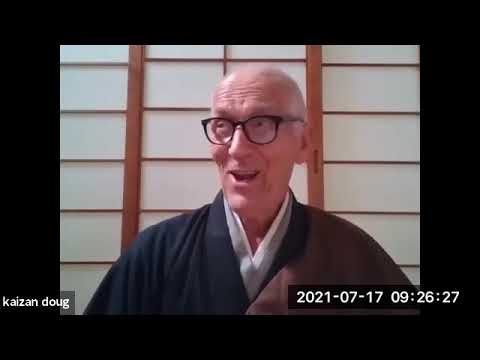
Taishin Michael Augustin — "Acceptance"
Sunday, May 11, 2025
All right, Taishin, welcome. Thank you. Thank you for that wonderful introduction. I was looking for some place to hide as you were speaking. Unfortunately, I can't do that. So here I am. It's so wonderful to be here and see so many familiar faces. As Chodo says, I was there from about 2012 to 2018, and then I traveled away for a while. And new faces. It's great to see that the sangha is still alive and well through many different transitions that we've all experienced together. So thank you very much for having me, and thank you for the invitation this morning.
This morning I want to explore the meaning of the word, or the extension of the concept, or the embodied practice of acceptance. It's a big topic, and I'm offering these three descriptions in part to acknowledge that we're not going to cover all the ground today, nor am I even going to try. I also offer them because of the way in which they're related to one another. So sometimes the words we use — in this case, the word acceptance — serve as ways of referring to a collection of things, though I'm tempted to say ideas here. What is acceptance? Somebody might ask you. Well, you say, it's kind of like this. Or, let me actually tell you a story that I once heard about acceptance. And this author that I really admire, she describes acceptance in this way. We tend to reach here and there for this and that thing because it's challenging to sum up just what acceptance is in something that might fit on a bumper sticker, for example.
It's not impossible, however, and I'm confident that if we had enough time, we could accomplish it. And if I had my way, this would be in the form of a poem or a Zen-style, perplexity-inducing story. And we'd probably wrap up our time together with Nyo Suisan saying, close enough for jazz. Such efforts are worthwhile in their own right. I consider conceptual clarity a virtue. Arguably, though, they're more worthwhile for their influence on our actions — how we practice our acceptance in our day-to-day lives using this body, heart, mind.
Our relationships afford unending opportunities to practice acceptance, including our relationships with ourselves. And that's really what I'm going to be talking about today. When we do this, we add more to the loosely bound field, this conceptual space that we sometimes reach around in and that I mentioned a moment ago. Thich Nhat Hanh might call this watering the seeds planted in the rich soil of our heart-mind. In time those seeds sprout, and in time flowers bloom. And the appearance of new life in this field influences how we use the words that refer to the practices of our daily life. Actions, speech, and thoughts that we did not previously see as acceptance are now recognized as such. So we have our words shaping our ideas, shaping our actions, and our actions in turn shaping our ideas and shaping our words, how we use language with one another. And this happens because nothing is anything all by itself, and everything is anything owing to the totality of all conditions present at any one time. Call this the preamble to a story that I want to tell.
Our story features a young man. Young here means early thirties. He's ambitious and too sure of himself and his abilities. This young man is also nearing the end of his graduate studies at a well-respected university. There's a lot to tie off before early summer, and he feels overwhelmed. In addition to that, he's already really tired, exhausted — I think the preferred term these days is burnt out. So what does our young man do? He reaches out for support, and in a familiar place, but it's not at all a wholesome one: the liquor store. All varieties of beer and whiskey become the means by which he continues to push himself. His behavior, his ambition, is reckless. While our young man senses that this is unskillful, he persists. The reset, the rationalization at the time, is that this is only for a time. This is temporary, he tells himself, and when all this is done, this will be done too.
Things don't unfold that way, however. There is temporary relief when the young man does wrap up his graduate studies and moves to another well-respected university for his first faculty appointment. The new environment gives great life. He's energized. He's filled with optimism. But things change. Soon, the responsibilities of professional academic life become too much for our too ambitious, too confident — in a word, deluded — young man. The unskillful behavior resumes, and it's worse. He's under the influence in the mornings and on the job. He begins missing work, feigning sickness to his colleagues and students, though he is sick in another and more significant way.
The young man falls apart near the end of his three-year contract and resigns to hide his now self-destructive behavior. We're long past that period when it was just about temporary relief from stress. This is subsistence until non-existence. With some time away, however, stability returns. Somehow the young man finds employment at another well-respected university. Don't ask me quite how this happens, but it happens. He tells himself, I learned my lesson, and it'll be different this time. It's not. In fact, things are worse than before. He misses nearly half the first term of his appointment, due in large part to not one but two hospitalizations. The young man lasts one month into the second term before falling apart completely.
Several weeks later, he finds himself sitting with fifty other people in a large circle. He's at a treatment facility for severe substance abuse. By all measures, the young man knows that he has a problem, and he's had a problem for some time. He put himself into treatment. No one compelled him to do this. There was no intervention on the part of friends and family. He found the facility, booked his time there, set his affairs in order, went off — and yet he can't bring himself, when his turn comes in this large circle, to introduce himself in part by admitting or acknowledging or adopting the label, or putting himself underneath the concept — we could use any number of expressions here, and it really doesn't matter which one we pick, because precision is not what's important. Gesturing in a certain direction is. An alcoholic. The words just won't come out. He stutters and stammers and looks down in shame, kind of in disbelief that this is where he is. He knows, but he hasn't accepted this part of the reality of his life.
In time, something does shift, and the young man is able to accept himself as he is. And in doing this, he accomplishes a significant step on the road to recovery. His life continues, and it does so in a different direction.
I've told this story several times now, and each time it's a little different and it's for a different end. Once I used it to explore the awesome power of attachment, or craving, or thirst — from one point of view, the root of suffering. This story that I've just told you unfolds over a period of about four to five years, and there are multiple instances where it's clear to the young man that this is not going well. There's a great level of dysfunction, and yet he keeps moving in this particular direction because he's craving something. He's attached to something. He's thirsty for something. And I can tell you it's not just beer or whiskey.
In another setting, I offered it as evidence for the unrestricted possibility of transformation. In the brief introduction that Chodo offered, it was mentioned that when I lived in Santa Barbara I was a student of the late and much-loved Koan Gary Janka Sensei. Many of you know that koans sprouted and flowered in the White Plum lineage of Taizan Maezumi. And when I was there, I read a lot of Maezumi's transcribed talks. And from a talk titled "Live the Life of Impermanence," I still carry with me the following passage. Maezumi says: in a twenty-four-hour period alone, we are being born and dying six and a half billion times. It's so fast we can't notice it. Our life comes about through causations — direct and indirect causations — and appears as conditions that are constantly changing. Having this body-mind is always a result of many, many causes, all constantly changing. And when we really see this fact, right there, there's freedom.
That freedom, the condition of all life, necessarily helped facilitate the young man's turning. He's grateful and humbled, I assure you. But today, as I said at the outset of this talk, I want to use the story I've told to explore this something we call acceptance.
The young man in our story knew he had a problem, but there was a barrier that prevented him from sharing what he knew with other human beings. It's pretty easy, I find, to share our secrets with trees, with non-human animals — like the two cats that are sitting in front of me right now, really trying to get in my lap, which is great given how many layers of black fabric I'm wearing — the stars, and the moon. In twelve-step programs, personal inventories are shared with God and with another human being. And sometimes people ask, why do I need to share it with another human being? Isn't sharing it with God sufficient? And the response, in short, is that sharing with God is too easy. When we sit down and share face-to-face with another human being, we're sitting down and sharing face-to-face with ourselves. The other person serves as a mirror, showing us what's here in this body-heart-mind. And that, I find, is not at all easy.
Our young man knew he had a problem, but he hadn't accepted it. And that's a really curious condition. And what's more, in time he would be able to share his story with others — a sign, I say, that he had come to accept that which he knew about himself. And so I want to ask the questions: what changed, and how did it change?
The Buddha taught that the root cause of our suffering, from one point of view, is the identification of ourselves with a construction. This construction is formed from our beliefs and our desires, our judgments and our preferences, labels we adopt, and a certain subset of all the relationships that we stand in, which come together from likes and dislikes, proximity and time, and so much more. Even though I stand in relationship to all things, I'm going to pick out these ones — with my coworkers, these ones with my family, these ones with people in my community — because these are the ones I either like, and I'll push away the ones I don't like. All of this kind of comes together. And sometimes I call this construction that we form the great story we tell about our lives. Some parts of it we know really well and we like to tell other people. Other parts of it we know less well and maybe we don't want to share them with other people.
Others call this the constructed self, the small self. And in a chant that I can't remember the name of, it comes up as ego delusion — which I think is a great name for a band, by the way. It doesn't really matter what we call it, however. What does matter is that we identify with this story. We believe that it's who and what we are. And in some way we can't ever quite articulate, we believe that it's separate from everything else. There's the entire world out there, and there's my story over here, and somehow these two things are separate from one another.
And this is really important, because identification and separation encourage uncertainty, and uncertainty encourages fear — particularly in the form of anxiety. Do things out there, things that I judge separate from me, want to help me or hurt me? And how can I tell? Are they, collectively or individually, friend or foe? And how can I be sure? I don't know what they are, only that they're not me, but somehow other. This chain and its reactions — identification, separation, uncertainty, fear, anxiety — has several more links. And among them, a craving for protection. One way we can and do try to protect ourselves is by hiding, endeavoring to keep secret those things that we believe injurious to how others perceive, interpret, and understand the great story we tell about our lives.
And I'm going to stop my armchair analysis now and simply say that it's not wrong to think this way. It's not wrong. It's not unreasonable. It's not silly. It's not mistaken. It's not incorrect. It's not foolish or anything else of a similar sentiment.
When you sail out in a boat to the middle of the ocean where no land is in sight and view the four directions, the ocean looks circular, and it does not look any other way. But the ocean is neither round nor square. Its features are infinite in variety. It is like a palace. It is like a jewel. It only looks circular as far as you can see at that time, and all things are like this. Although there are many features in the dusty world and the world beyond conditions, you see as far as your eye of practice can reach.
Those are not my words. I wish they were. Those are Dogen Zenji's words from Shobogenzo Genjokoan. And there are some good words.
Whatever your story is today, or this week, or this month, or this year, please remember that it's only a story. It reads as it does because of where you are right now, and where you are right now is constantly changing, as Maezumi reminds us. But I feel like I'm digressing, so we're going to go back to our young man.
The story with which I opened this talk is part of the young man's great story about his life. He knows it. He identifies with it. And at the time, it's so dominant that he believes it's the whole of who he is. The young man dares not, however, accept it — for fear of how others will perceive him, and for how he must see himself. He believes that if he does this, he's going to be destroyed. Poof! It's going to vanish.
But as he sits and listens to those also in the circle with him at this treatment facility, who are sharing some and similar parts of the great stories about their lives, he observes that not happening to them. They don't just go poof and vanish into thin air. They continue on — laughing and crying, trying their level best, and recommitting when things go awry. They're still very much alive and well. So the young man takes a leap of faith. He tries the same himself, giving his story away through sharing it with those present. And behold, he too doesn't vanish. There's no poof here.
And it's simple to see why. The young man was, as all of us are always, more than the great story he told about his life. He reconnected with that whole, all-inclusive self when he accepted the part of it in which he repeatedly abused alcohol, contributing to great suffering for himself and others.
And how did that happen? He let go. He let go. In fitting Zen fashion, he accepted the reality of his life by letting go of the story he'd been telling about it. This letting go, by the way, doesn't negate the harm that arose from unskillful behavior. It doesn't minimize the suffering that was co-created by unwholesome actions. And furthermore, it's not an abdication of responsibility to try setting things straight through making amends. The story is still there. It's still important. But now, the story is in its proper place.
As I bring this talk to a close, I want to stay with this expression — proper place — and offer two teachings that gesture in its meaning's direction. The first is from Dogen's Shobogenzo Genjokoan, and some of you I know have heard it many, many times:
To study the Buddha way is to study the self. To study the self is to forget the self. To forget the self is to be actualized by myriad things. When actualized by myriad things, your body and mind as well as the bodies and minds of others drop away. No trace of enlightenment remains, and this no trace continues endlessly.
That's pretty good. But we can also say it in this way: to study the Buddha way is to study the great story we tell about our life, in all its chapters and verse. Studying this great story is at the same time letting it go. Letting go of our great story is accepting the all-inclusive reality of our life as it is. When accepting our whole self, the chapters and verse as well as the chapters and verse of others reside here and there, none dominating. Buddha's boundless field. Grasping and pushing away cease, and the resulting rest continues endlessly.
But that's a lot of words. Maybe you want something a little bit shorter to carry around in your pocket from day to day. So I'll give you a second teaching, which is significantly shorter. Joan Didion opens her essay "The White Album" with the simple sentence: we tell ourselves stories in order to live. And I add: and we let go of our stories to keep on living.
Thank you very much.
---
Chodo: Thank you so much, Taishin. A wonderful, thought-provoking presentation. And of course, no surprise, having studied with you. Your words are too kind, but I will accept them on this Mother's Day. All right. Well, we're going to take a deep breath and let people think about what they'd like to talk with you about. Our format will be: hands together, look at me, and I'll acknowledge you, and then you can voice your question or comment to Taishin. Anyone like to get us started? Just if you could state your name, because he may not know you.
Question: Great talk. Thank you. As you were summing up that last line, I was thinking of a sister of mine who has not studied Zen or anything, and is a bit of an alcoholic and this and that, but she's very functional — CEO of a company and everything. But one of her sayings — I don't know where she got it — is, "Oh, get over yourself." Get over yourself. I mean, I guess it's common parlance. I don't know.
Taishin Michael Augustin: That one is a great one too, to tell oneself when you're getting all bollocks — get over it, or get over yourself. It's a great one. Yeah, thank you for that.
Question: Hi, I'm Erin. Your talk was really wonderful. It was thought-provoking, as you said. Two things I really connected with. One was when you were speaking to identification and separation — they were such a feedback loop. When I identify with the story, it just in some way creates even more uncertainty, and then I go back to re-identify because of that fear. Oh, now I'm over here feeling separated — I think it's so deep in our bones, you know. Just sitting with that experience.
I also love that you quoted Joan Didion. It reminded me actually of a Native American woman writer. She said something that for a few years I've just been obsessed with — it's just been in my mind a lot. And right when you said that, something kind of clicked. She says, in a long essay, "A story is an energy, and our stories are our ancestors." And I've been almost in a koan relationship with that. It's in my home. Like, what does that mean? And I'm dancing with it. So that gave it another quick twist of the Rubik's Cube. And again, I just love your insight with Didion's comment — how we can look at the story — which makes sense to me because I also relate to the world a lot in terms of energy. It's just energies moving, and not attaching, especially with other people, to not get attached to their story. Like, what's the energy moving through? But then the other aspect of being shared and alive and having responsibility to who we are on this planet — a story of our family, a story of whatever it is that we're in relationship with — honoring those stories, because they do comprise who we are, part of who we are, in body. And I have come to see them differently. Whereas before, when I was younger, I was always struggling to let go of all of them. Somehow proving that I'd transcended them. So thank you for that too. Both of those are an impetus to go deeper into that something.
Taishin Michael Augustin: You're very welcome. And I'll offer one more side to the Rubik's Cube, one more color for your enjoyment or frustration. A teacher I worked with for a while said to me: our stories are like fossils of a life that's already moved on. And I hold that one close for precisely the reasons that you're offering — that they're important. They make up who and what we are, and we have an important relationship to them, and we still need to look at them because we can learn from them. But like fossils, they have a place where we can go and spend time with them. They don't need to be front and center all the time, like they sometimes can be. They don't need to be the lens you're looking through in your present life all the time. You can pull them off the shelf when you need to relate with them.
The other thing I feel inclined to say touches on this idea of a feedback loop that you mentioned. I was reminded of the Buddha under the Bodhi tree many, many years ago, and how Mara — supposedly Mara comes and says, what right do you have to awaken, Buddha, dude? It's like great doubt coming, right? The personification of great doubt. And what does the Buddha do? He touches his hand to the earth and calls the earth and all living beings to bear witness. It's this great leap, I think. He doesn't know what's going to happen, but it feels right to reconnect in that way and jump outside of this great doubt that we can get caught in — can I do this? I don't know. I need others to support me as I try to move outside of this little cage I've built for myself. Thank you.
Question: Alan. I have some chaotic thoughts, and maybe you can help put them together. Sure. Digestive systems of cows and people — we consume very different things, but I've heard that the final product is the same: glucose for energy, and then other things for bone and tissue. The digestive system is very different, but ends up with that final product. So relative to acceptance and the story, the thought that comes to mind is: are the stories that we tell ourselves, given that there are probably eight billion different stories on the earth today, leading to a similar product? What is that? Is there a final product that these eight billion different stories are leading to? And then the second question would be: is there an attitude relative to ourselves and others which will help produce that final positive product?
Taishin Michael Augustin: Those are two fantastic questions. So the first question is, is there some one end product that all these stories are leading to — similar to the food we take in and the food that cows take in, all producing the same end thing, just in different ways? The response that leapt immediately to mind was liberation. It's tempting to say this is the centerpiece of practice, but I dare not say anything is the centerpiece of practice. But an important part of practice for me is just that transformation of ignorance into wisdom, transformation of suffering into liberation. And what feels alive for me right now is that the stories are a kind of fertilizer that we use to water wholesome seeds in the heart-mind, and when they sprout and flower, there's an instance of awakening. That's what it's all working towards, in its own way and in its own time. For some people it might take a year or two. For others it may take multiple lifetimes. And in that case, I'm really glad that we might have multiple lifetimes, because I've got a lot of work to do, and it's not all going to get done today.
And what was the second question — are there attitudes that we can offer for others to help make a positive final product? Not knowing feels really important there. When I think about what has gotten me into trouble in my younger years — I'm an old man now — but in my younger years, it was thinking I knew everything. I didn't have a whole lot of humility or gratitude. Another thing that comes to mind is a willingness to just try things out and be surprised by what the results are. This willingness and not knowing seem to go hand in hand. And the third I might describe is rigorous honesty, which isn't pushy. It's not combative. It's not in your face. But an attitude of being transparent with others and with yourself about where you're at. And if you can do that, certainly you'll be okay, and you might be able to support other people who are in places where support is needed and welcome. Does that answer the question, or at least give something to work with?
Alan: Yeah, that's really good. I'll just have one brief comment. That binary attitude — right answer, wrong answer, score the touchdown good, get scored against bad — I experienced that same thing. I said, boy, when I was fifteen, I had an answer for everything, and life was kind of a burden. There was a little stress in being infinitely knowledgeable. Now it's better this way.
Taishin Michael Augustin: Yeah. The truth is not a thing.
Question: Hi, Taishin. It's Emi. Hi, Emi. Thank you for sitting with us and giving us your talk. There are so many things to comment on, and I love hearing everybody's thoughts as well. The idea of acceptance and validation is so important, I think. And it seems to resonate with me — this idea of getting close to our story, or who we think we are, and then backing up. And letting go. Because for a long time I was thinking, let go — let go of what? It would bother me. So the invitation to notice your story, and the whole idea of being validated by others — it's so important, because we could hide from ourselves. Imagine that. Anyway, thank you. See you soon.
Taishin Michael Augustin: Thank you. And yeah, I hope to be in California before too long, though it might be a little while still.
Question: Augie, if I could call you Augie. Sure. I used to call you that. Your last name, Augustin — you've got a Pope now. So your name takes on a different meaning. Congratulations on that. You didn't go to Villanova either. I want to say thank you. You're just as much of a rascal as I always remember. Some things don't change.
One thing that came to my mind: when you were in the doan team and playing the fish drum today — Josephine did her first drumming today, by the way. Congratulations. Well done. And you always looked at me, and we said we always threatened to go full speed like the Japanese temples. And we said, our sangha can't handle that. So we never did it.
Taishin Michael Augustin: I'm still threatening.
Question: A short story. During the pandemic, there was this old man, and he was drinking more than usual, because out of boredom most people drank more during the pandemic. Full disclosure: I go to my medical exam and you check the box — two drinks, two to five a week, one a day, ten a week, more than seventeen. And I just checked two to five, you know. And then the radical honesty. Oh my God. Dinner's not ready. I'll just have a little wine with cheese. Oh, a beer with dinner is nice. And afterwards, a whiskey would go good watching TV. I added them up — seventeen a week. And I just quit. Didn't need a twelve-step program. But sometimes confronting your honesty leads to something that says, I have to change. So thank you for your radical honesty and for this talk today.
Taishin Michael Augustin: Thank you, Nyo Suisan. I was so excited when I saw you in that seat, because I too remembered — we would look at each other and be like, is Koan gonna be ready for us to go full speed? I can imagine him saying slow down, because we never quite did it. And yeah, thanks for sharing that about your time during the pandemic. I think everyone caught on, but I'm the young man in the story. And yeah, that was a really tough time for me too. But it took a little bit longer for me to find my way through. I'm glad you didn't have to go through some of that stuff.
Question: Just one more — to tag on about how bad habits can creep in. And this talk shines light on that. Except — look at the bad habit, like the alcoholic in the twelve-step, you know. We've all got our own programs privately, these different things. So they're all great reminders of being honest and looking at our behaviors and letting go — accept and then let go and change. Knowing that your body on the molecular level is constantly dying — that was a beautiful analogy too, you know, to realize that you're not trapped in the bad habit or the self that you think you've been, that you have that opportunity. The body's changing all the time. So go with it and refresh. So anyway, it was very applicable to that type of thing — bad habits, looking at them. Yeah.
Taishin Michael Augustin: Yeah, it's Josephine, right? Yeah, thank you. When I look back on that period of my life now, I am amazed at how slowly it started. It seemed perfectly innocent, in the way that many unskillful behaviors that grow to become really dominating in our lives do. And all of a sudden — when did it happen that I had such a dependency and such a challenge functioning without this particular substance? You can't really pinpoint it. That's how subtle the shifting was over a period of time. And then — I wish I could think of a way to help younger me, or those who are still struggling now, see that freedom that's always present. I was carrying around that quote for a long time before I really felt it. It was just kind of this intellectual idea — yeah, it's out there, it somehow relates to my life. But when the change started to happen, it was like, oh. And I could have done that a year ago, two years ago, if only I had been willing. And I say that without judgment, right? I just wasn't ready at the time to get the support that I needed. So thank you.
Chodo: Any last comment? We're coming up on the hour. So if we have another question, we have time. Otherwise, we'll call it.
Question: Hey, Lisa. Yes. Lisa, not a question. I'm delighted to be here. And I'll always remember — we were together, paired together for an exercise. I remember at UCSB, Koan was doing these exercises. It was just really lovely. And I'm very happy to see you again. Look forward to it in person.
Taishin Michael Augustin: Thank you, Elisa.
Chodo: Taishin, it feels like family having you with us. And what a wonderful presentation. I think I've learned a lot from teachers who are strong and certain in their presentations. I think I've learned more from teachers who are vulnerable and open-handed, and who talk to us about the liberating nature of that. So really, so grateful to you. Have a wonderful Mother's Day. Thank you for being with us.
Taishin Michael Augustin: Thanks, Chodo. And thank you, everyone. Hope to see you again soon.