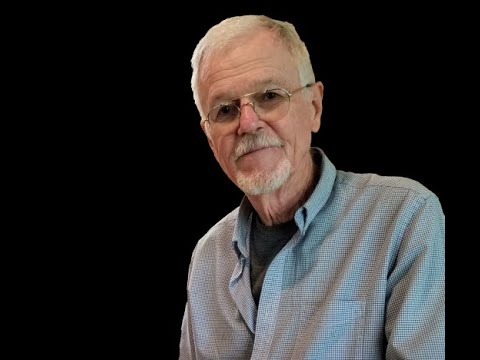
Alan Eustace — That's not a pothole, it's a portal!
Sunday, April 13, 2025
Welcome, Alan. You have the portal.
Thanks, Dave. Hi everybody, can you all hear me okay? Sounds okay, cool. I speak a little bit softly, so just put a hand up if you can't hear me.
Wonderful to be with you via the amazing causes and conditions of electrons and electricity and light and things, so I can be there on Zoom. Maybe I'm more present there than if I was there in person — who knows.
I've been to Santa Barbara — was there a couple of years ago for the first time and felt very at home there. I really appreciated it. I felt a real gentleness in the air and a sort of softness, probably helped by the weather. I remember the colors of some of the older buildings, and yeah, I have fond memories of being there.
My partner's first name is Barbara too, and it just — when I moved to California, which was about six and a half, seven years ago, it only struck me like three or four years in: oh my goodness, all of these city names like San Francisco and Santa Barbara and San Jose — these are all saints, and obviously Catholic saints. But I like to think, I hope these were wise ancestors, you know, maybe so. I want to learn more about Saint Barbara. I love that it's a female name, and yeah, I have some curiosity about that. It just struck me joining this morning — I wonder who Saint Barbara was.
I will say, whatever I share today, I like to think of it as really just encouragement for your own practice. I like the phrase "experience, strength, and hope," so I'll share a little bit of what's helped me on my journey, and I hope it's helpful for you. I have a particular interest in making practice accessible, and I'm really interested in language. I write — fiction and poetry — and I really love language. I think there's a lot of power in language, but we can also get really tied up in knots with language, and I think there's a lot of playfulness in language too. So that's kind of evident in the title of my talk.
I live in Oakland in the Bay Area, and I don't know if you've been here, but there are a lot of potholes in Oakland — kind of perennial potholes, occasionally they get paved. I grew up in Ireland in the eighties, and there were a lot of potholes in Dublin when I grew up, and not a lot of money to fill them. Things have changed and Ireland's become very polished, you know, for lots of reasons. I have a lot of nostalgia, and when I see a pothole I feel at home. I feel really at home when I see one — there's something about it I really like.
So I wanted to name that, and part of what I want to share today is I'll reflect on a couple of notions that are central, I think, to our practice — the concepts of practice and enlightenment, the idea of already being whole somehow. One of the things I really appreciate about our practice is its orientation to challenges or difficulties. When we do encounter a pothole — and it kind of feels right now like there are just lots of potholes in the world — there's a way in which, and I would actually say this: I think it's both a pothole and a portal, because there are potholes, yes, there are actual potholes, and there are difficulties. People pass. We encounter — this is part of our practice — an open-eyed seeing of difficulty and suffering, a term we might use. But what I find really generous and graceful about our practice is a way of being with that. So the pothole is also a portal. Those difficulties are also a way in and a way through.
I was talking to my teacher Tim one time, and I had this question for him: I feel this ache, I feel this longing in my heart sometimes. I feel this really real ache, and sometimes it feels like a hole — you know, maybe like a pothole, it feels like a hole. I asked him, does that go away? How do we work with that? And he didn't say anything. As he was sitting there in silence, it came to me — because he'd been saying to me continually, feel into your sensation and be with what's there — it struck me in that moment that the way to work with that is to really just be with it, and keep it company, and get really intimate with it, get really familiar with it. And not in a "there's a problem to be solved" way, not going to figure it out in my head, but rather in a more childlike, curious way — from a heart of compassion, from a heart of tenderness — just to be with that hole.
And what struck me — even in that moment, I did that. I just took a moment, I took a breath, I just let myself feel into that ache — and I noticed that it's really alive and it's really rich, and that somehow it's not a hole. I know this is sort of — I don't mean to over-egg the playing with words — but there is wholeness there. So that distinction between a hole and being whole. And then of course — I don't mean "of course," it just struck me in that moment — I'm sure we're all familiar with the figure of an ensō, the Zen circle. And I was like, oh my goodness, it is a hole, but it also contains everything, and it is also nothing, but not nothing in the negative sense — although there's lots of space in it, it's really full. It's really, really full of everything.
So I just really appreciate that our practice is such a grounded, gentle, embodied way of working with all of that — working with what it is to be human. I mentioned embodied because when I came to practice, so much of what I came with was: I'm going to figure this out. I love ideas and I love to read and I love intellectual pursuits, and I was going to crack this thing, because I'd lived a lot of my life that way. I now realize that as a sort of survival strategy, I had to come up into my head. Much of my practice journey has been the short but very long distance from here — you know, my neck — and then down below, into the rest of my body. So it's about being grounded in all of that.
What I appreciate about our particular way of practicing is we attune to our experience from a full body-heart-mind place of practice. And our practice is so simple — I mean, we sit down on a cushion or in a chair, maybe we lie down. Maybe when we lie down we fall asleep, we have a little nap. That's okay — I'm a big fan of napping. I don't know if you've ever heard of the book Rest Is Resistance — a lot of praise of napping in there. But there's a way in which we just pause and let ourselves be and be still, and just be with what's here as best we can.
I sometimes think about the word mindfulness. When I first encountered practice and first encountered Zen, I was reading some books about mindfulness, and I think like all of us I wanted to do this right. I wanted to be a good student and a good practitioner, and be mindful. And for me that looked like moving very slowly, doing it the right way, having a perfect posture. I really wanted to crack this, to just do it properly.
Lately, words like heartfulness or playfulness — other things that help us attune — feel truer to what this is, because really this is a very, very simple practice. It's really just bringing some gentleness, bringing some lightness to ourselves. And I think that's really one of the most important things — to bring some kindness to ourselves, and then to our experience, just pausing and making a bit of space for what's here.
I'm sharing that as some background to what I wanted to talk about today. This talk is a little bit circular and it'll be a little bit of a ramble, because I find when I share thoughts on practice it's always the same ideas, but I'm always trying to find fresh ways to express it.
Really, I guess, the anchoring idea is: we practice, and somehow in our tradition we're already enlightened. I like to say — I'm sure you've heard the Suzuki Roshi phrase — "You're perfect as you are and you could use a little improvement." We make effort, but we make effort from a place that trusts, or at least wants to believe, that we're already whole.
So I think of another set of words: the word whole and the word heal. They have the same etymology — whole, W-H-O-L-E, and the word heal. So somehow, rather than being broken and needing to be fixed, what if we're already radiant, whole beings? Yes, we have experienced difficulties, and there is some wounding, because that seems to be part of what it is to be human. Part of our journey in our practice is to allow healing to happen. It's my experience now — it was my belief, I wanted to believe it but I didn't for a while — and now it's my experience that healing actually wants to happen. Healing, unfolding, growing has its own energy that just wants to unfold. There's a way in which, when we can pause and just be with our experience, it seems to support that happening.
I'm brought to mind of a California poppy. I love the California poppy — it's new to me, because we have poppies in Ireland but they're not like the classic California poppy, they're sort of a pinky light red. They grow wild, and there's something about the metaphor of a flower or a plant — this idea of potential, and this unfolding, this very organic, natural growth that wants to happen.
So I guess what I'm playing with here are different metaphors or ways of attuning to our practice — less about "we're going to make something happen," and I know I felt that way — and more about attuning, or letting go, or settling in.
There's a phrase in one of Dōgen's fascicles — I think it's in Bendōwa — where he says, and I'll just read you some of these words: "It is never apart from this very place. What is the use of traveling around to practice?" It's never apart from this very place. It's right here. No need to go anywhere. It's beautiful to travel to practice, it's beautiful to visit centers and to encounter other practitioners, and I love the idea of pilgrimage — and yet, foundationally, it's never apart from this very place.
And then he says: "If there is a hair's breadth deviation, it is like the gap between heaven and earth. If the least like or dislike arises, the mind is lost in confusion."
I remember hearing that phrase — "if there is a hair's breadth deviation" — and I was looking this up yesterday. I wonder if anyone knows how wide a hair is. I certainly didn't. How many hairs would it take to create an inch? The internet told me — and I'm sure many of you are thinking, well, it depends on the hair, I've got fine hair or I've got thick hair — but there's a range of something like 140 to a thousand, and the sort of average is about 250 hairs. So it takes about 250 hairs to fill an inch. One two-hundred-fiftieth of an inch is the fineness of the gap between heaven and earth.
I remember when I first heard that phrase, I'll be honest: I was like, oh crap. If I miss it by that tiny, tiny amount — like I've missed it. That's so easy to miss. That's such a tiny, tiny thing. How can you pay attention to something that small? I'm just going to miss it all the time. Obviously. So kind of, what's the point? Let's just give up. I continued to practice, but I remember reading that phrase and really feeling discouraged by it.
And it struck me at some point in the last couple of years — I don't think he means it that way. The way I like to interpret that now is: the return. The return to just this. The return to a tender heart. The return to a memory of some kind person you've experienced in your life, or even some kind person you've never met but can evoke. The remembering to remember — the shift back to that — is tiny. You don't have to strive and strive and strive. It's just like, oh, there I go again. And it's just the subtlest little — I can just let go a little bit. It's just this micro, okay, it's right here. It's right here.
I experience that as a really gracious, generous, and kind way of orienting to our experience and to our practice — every moment, whenever we remember. Even when we're sitting on our cushion. I don't know about you, but I know a lot of my sitting on a cushion has been filled with: you suck at this. Like, you really — this is terrible zazen, your posture is really bad, your legs hurt. And then all sorts of other stuff.
And I love the gentleness of phrases like: when you sit in zazen, keep your front door and your back door open, and let your thoughts come and go — just don't serve them tea. Just let them come and go. Don't invite them in to hang around. Or the phrase — the title of the book by Uchiyama Roshi — Opening the Hand of Thought. When we're gripping onto things.
I like to do this guided meditation for folks where we imagine we're sitting on a beach by the ocean. On the out breath, the waves are coming ashore — you can see the beach now in Santa Barbara. The out breath, the waves come ashore. It's kind of interesting how our breath makes that wave-crashing sound if you listen to it closely. And then on the in breath, the waves are receding. I invite people to imagine a beach that feels safe and comfortable, you know, not too hot, not too cold, and just breathing with the waves.
At some point I like to mention: you might notice thoughts arising, and I like to frame those as birds in the sky on your beach. I don't know what it's like down there right now — I was in Dublin last year and I'd forgotten how many seagulls there were. Very large, loud seagulls. I remember staying in this house and just hearing them in the morning. So in this meditation, are there birds in the sky? And if there are birds in the sky, just imagine those as your thoughts. Whether there are lots of birds, a couple of birds, no birds — not one is better than another. It's just birds doing their thing.
I like to encourage people that if you find yourself stuck on a thought, imagine that you're cradling a bird in your hand. The bird has landed in your hand, you're kind of holding on to it a little bit. And just that very gentle micro-adjustment of relaxing your grasp and letting the bird fly away — or maybe the bird just sits there with you, sits there and breathes calmly in your hands.
Really, I feel like the heart of our practice is this very, very gentle, subtle, hair's breadth return. We can return and we can return. It's just a really subtle just-remembering.
I was at an event related to working with the body — I think it was based on somatic experiencing, or something informed by that — related to healing and working with the body. They did this practice, and you feel free to do it with me if you want. What they talked about were these micro-movements. The movement we were doing was just imagining painting an S in the air with your nose, with just the subtlest movement — like moving your nose up and to the left, and down and to the right, by the width of a hair. So there's something about how the shift here is really tiny, and that tiny shift is so significant.
I think about how when we sit on our cushion and we find some comfortable way of being, or we sit in our chair, and we do these very subtle things — like we hold our hands in this mudra, the cosmic mudra, which of course has this circle, or this hole that is also whole with a W, and somehow encompasses everything — and we just let our awareness rest there. And then when we drift away, which we will, the gentle return. We might notice our hands have become a little bit tense, and we can just seek to release the tension by a hundredth of a percent, which is the tiniest of rememberings.
I wanted to share that because — I speak for myself here — our practice, especially as Westerners, whether we grew up in a religious tradition or not, we were certainly schooled in ways of being in the world that involve all sorts of good things but a lot of focus on doing and achieving and making things happen. The channeling of energy in pursuit of something — this is really beautiful, in many ways. But when I came to this practice, I brought a lot of that achieving-and-doing energy. And then there are all of these forms, and so I wanted to do this perfectly, sit perfectly, get it all right.
What's really struck me over the years is — in Zen Mind, Beginner's Mind, in the preface, there's a phrase where Suzuki Roshi talks about beginner's mind. If you read it and go a bit further down the passage, what he effectively says is: the beginner's mind is the mind of compassion. So really the heart of our practice is this great compassion, this great gentleness, this great allowance for what's here — for ourselves, because we have to start with ourselves. But that's not to say we don't also have a very strong backbone. It's one of the things I love about the metaphor of our practice: to sit upright. I've heard it described as a soft front and a very strong, upright backbone. So we have agency and we can move and we can act and we can have a voice — but grounded in this knowing that really, what's truest about us is we're already whole. That's really more true about us than anything else. And when we forget, the returning is just this tiny little remembering — no more than the width of a hair. It's just like, oh, okay. It's right here. It's right here.
I'll just mention — there's a really interesting paper online, if you're curious about this kind of thing, on the phrase "practice-enlightenment." I was curious about the origins and etymology of those words. In Japanese, the phrase is shushō ittō, which translates something like: shu means practice, shō means realization as the fruition of practice, and ittō means oneness and equality. So the phrase means the oneness and equality of practice and realization — this idea that we're perfect as we are and we could use a little improvement.
I've been recently reading the memoir of Marsha Linehan — and many of you may have heard of her, she created Dialectical Behavior Therapy, and she actually trained as a Zen teacher as well. Her whole approach is about acceptance and change. The two parts of it are: can we accept, can we be with what's here — which we might call realization or enlightenment — and then there's this move to act, to change, to have agency, to support our own journey of awakening and healing. It's a real paradox. We are both of those things. And that's part of what I love about our tradition — yeah, it is both, and that's okay. To be human is to struggle, and is also to experience great joy. In our practice we're really working with both of those.
I'll just share a couple of other things as I see the time here. I grew up Catholic and was sort of steeped in prayer. Prayer to me was just a thing you would recite, and it had no meaning really — it felt a little bit lifeless, very dry. There was a lot of shame and guilt involved. I sometimes describe myself as a recovering Catholic.
In recent years I've come to really appreciate the essential mystical heart of all faith traditions — and even traditions, humanist traditions, that are not about faith. I'm really curious about the essential mystical roots of all of these traditions, that predate organized religion. I do trust and believe that it's a very human thing, and that these traditions have come out of this very human experience and need.
But I wanted to share that our practice — especially as we sit in silence, and we have lots of devotion in our practice, singing and chanting — sometimes times are tough. I don't know about you, but I sometimes feel the need for some help. We practice with each other, and we may have a teacher or a spiritual friend that we talk to, and that's really wonderful. But sometimes just during the day I feel like I kind of need to invoke something bigger than myself. And it's not going to be God — unless you interpret God as the universal energy of love and dynamism that permeates everything, in which case I could be down with that — but sometimes it feels like it needs to be a little bit more specific.
So I wanted to share, in the last couple of moments here, some things I've found helpful. When I practiced in the Tibetan tradition, we used to do a practice called White Tara practice. We would do this hour-long practice, and the first part was a guided meditation where we'd visualize the deity White Tara. White Tara is a manifestation of Avalokiteshvara, the Buddha of compassion, who appears in multiple forms — male, female, non-binary, all sorts of different forms. White Tara specifically is a figure of healing and compassion.
In that practice we would sit in the shrine room — a Tibetan center I used to practice at — we'd be sitting there chanting, and you could have your cup of tea and be drinking as you practiced. Every now and again the door would open and a dog would crawl into the shrine room and just kind of plop down on the floor. There were cats in the center too, and a cat would actually curl up next to the dog sometimes. One time, one of the dogs actually peed on the floor during practice, and there was just lots of room for all of that to happen. It was a very lighthearted, open space of practice.
We would recite the mantra of Tara. The mantra of Tara is: Oṃ Tāre Tuttāre Ture Svāhā. We would recite that mantra 108 times. The practice was you'd recite it out loud a couple of times, then soften and soften back to a whisper — the idea being you would whisper it no more loudly than so that the sound wouldn't pass the collar of your shirt. One of the things I wanted to name is that subtlety — starting aloud and then getting more and more subtle — to me is just another signal of this hair's breadth quality, this focus on subtlety, and not as a thing to go after but just this gentleness of a whisper.
Sometimes when things are tough — and when I say that I mean when I'm working with something I'm finding hard and I feel like I need extra help — I will turn to mantra. I will turn to the Tara mantra, and that's been very helpful, because I can imagine this figure. And even though I know somehow that this figure and I and we are all the same, and somehow each of us is the Buddha of compassion, it's helpful to just — I love the phrase "throw yourself into the house of the Buddha" — to just kind of throw myself at this White Tara figure and be like, I really need your help right now. Can I phone a friend? And just really inviting that in. That feels like a very human need, and something that is available to us.
I remember reading — I think it was Uchiyama Roshi, I think it's in Opening the Hand of Thought — talking about being in hospital and not being able to sit zazen and reciting the mantra, I think it was Namu Kanzeon Bosatsu — praise to Kanzeon, the Bodhisattva of compassion, or Kannon. Just wanted to offer that to you.
I've even at times found an old Catholic prayer, because I wanted something with words like "help me, I need your help, can I please get some help here." So I found one of those prayers and changed the words — for me it was Kannon — and changed the wording to add that in. That was a little extra level of support.
I also find great solace — and again I'm sharing this as support for your own practice — in music and poetry and the words of others who have reflected on these things. We recently went to see the singer Miché Meshé — she performed here in San Francisco. She's wonderful. If you're interested, there's a Tiny Desk concert of her performing some of these songs. There's one song called "Love," and I really see this as a prayer. I wanted to just share a couple of words from it. She says:
Well, when it dark, it hard, will you seek to solve yourself?
Me, I take the darkest corner, whistling to myself.
I love that phrase. It strikes me as such a great metaphor for ourselves in practice — take the darkest corner. We sit down, we face the wall, sometimes we're in the corner of a room. And "whistling to myself" is such a rich image, and sometimes when we're sitting there we can hear our breath whistling.
And then she says:
To live in love is to be uncertain.
To live in love is to bear the burden of so many who yearn to know my life matters.
Our lives matter. I feel that really resonates with our Bodhisattva vow — when some of us take vows to continue to practice and to help others. Marsha Linehan talks about her own mental health struggles, and she vowed: if I get out of hell, I'm going to go back in there and help everybody else get out of hell. And that's really what she has been doing.
And then the last words in this song that I'll share:
Love takes off the mask that we fear we can't live without.
Again, I feel in our practice just this very gentle returning and returning, and that hair's breadth remembering — very subtle letting go. We can let the mask, we can let the protection, we can let the barriers dissolve just a little bit. We have to take care of ourselves and some of those barriers are there for good reason, so we don't want to rip things out in a way that's not safe — but we can just allow, very, very gently, those things to settle.
There's lots more I could say, but I am aware of time. I had a whole poem I was going to read, but I want to make time for any questions and conversations. So I'll just say: my encouragement, if there's anything you take away from this, is to really channel the heart of this — which seems to be about being good to ourselves, being kind to ourselves, and then bringing that to others. And the move to remember that is a really subtle and small one.
Wonderful to be with you. Thank you very much.
---
Dave: Thank you, Alan. Really, really appreciate your sharing the dharma with us this morning. You've invited us to react and ask questions or make comments, so I'll be quiet and we'll just do that by raising hands. If somebody has something they want to say or a question, raise your hand and state your question.
Question: I agree with you about that hair's breadth — when I first heard about it too, it seemed, well — not hair's breadth, but — is that how it goes? It's the Xinxin Ming, isn't it? The Faith Mind Verse? But I love the way you gave us that analogy — just so close, and like a split second to come back. Just turn it around, you know, when we get off track, just subtly and softly. Thank you for that.
Alan Eustace: Thank you.
Question: I was taken with the phrase you mentioned from Beginner's Mind — I've not thought of it in this way before — that the beginner's mind is compassion. I'm not exactly sure how you said it. And I was noticing how my mind first went to: oh, that's so simple to apply with people. Really, when I'm standing there and the mind starts making assumptions, I just hop into beginner's mind, and so often when I do that I open up more and more to that person and realize: oh, I had no idea what was going on. I was making all these assumptions about why you were behaving this way. But what I hadn't taken in fully was: I don't really use that with myself. So I could be in that same kind of relationship with myself — taking notice, with all these assumptions I make about myself, all these judgments — stopping and applying that same path towards myself. And even saying that feels like a mountain to climb compared to offering it to someone else in the relational space. But I really appreciate you bringing that up. It's something fresh that came alive for me out of that statement. Thank you.
Alan Eustace: Thank you. What you just said there just struck me — I haven't thought of it that way before. I certainly know the experience of meeting somebody else and having all sorts of assumptions, but I actually haven't thought of it like — goodness, all the assumptions I make about myself. So thank you. That's fresh for me.
Question: Another thing I just want to mention is that when you're walking along the beach and the waves come in — for me, that's an inhale. I've got to say exhale. It just feels important. Why do you see it as an exhale when the wave comes in?
Alan Eustace: And I actually thought, well, this is a really fresh take. I'm breathing this way — this is a different experience, because my mind just kicked into what you're saying. It was like the exhale would be the water moving out, and so the water moving in would be the inhale. And so I had a very different experience breathing in that way. I appreciate it.
Question: I kind of had resistance when you said that — like, wait a minute. But these are the things with our assumptions, the way we think something is. And then you turned it around and I was like, oh, okay. I'll try it.
Alan Eustace: Yeah. I'll just share on that specific point — I was started out doing it that way too, and then at some point, because in that meditation it involves imagining being the ocean, and how whatever's happening on the surface with the waves, at the depths of the ocean there's always this stillness and this dynamism, and then somehow being and breathing as the ocean — but I can see both as beautiful practice.
Question: If you are the ocean, you can see how the ocean is breathing out when the waves come in, and then breathing in as they recede. What I find — I go down to the beach a couple of times a week and I play my flute, and the waves break about every seven seconds and my breath lasts about seven seconds. So I'm doing a duet with the ocean by breathing with it. And that's just another way of doing it. Thank you.
Alan Eustace: Thank you. I want to come and hear that.
Question: I'll jump in here. I just wanted to thank you for your talk, and also for bringing in permission to ask for help. So much of this practice is solitary and inward, and even though we can practice in a group, so much of what we're doing is gaining some mastery of ourselves, and sometimes that's not enough. I was reminded as you were talking of studying the Awakening of Faith — if you're not familiar with it, it's a very small text but very dense. The heart of it is tathāgatagarbha — Buddha-nature, the seed, the womb — and it goes into great depth about our practice going inward, the solitary. And then like the last couple of pages, it basically says, well, if that doesn't work, then pray to the Buddha. I mean, I'm sure I'm forgetting a lot of details, but I found that so humorous and just light and compassionate — that there are, whether it's people or energies or Bodhisattvas or whatever speaks to you, the earth mother or whatever, that there are moments that we can surrender to something larger than ourselves and gain some support from that too. So thanks for that.
Alan Eustace: Thanks, Monica.
Question: So your title was "That's Not a Pothole, It's a Portal" — did I get that right? What really made my heart rejoice was when you talked about this thin hair and the subtleties of understanding each pothole as a possible portal — to maybe development, or maybe completeness, more wholeness than before, something like that. So it was really touching to see this bliss of the subtlety. English is not my maternal language so maybe I am not able to express exactly what I want to say, but I just want to give you back this feeling of rejoicement. Thank you.
Alan Eustace: You expressed it perfectly, beautifully. And I feel it. Thank you.
Question: I could resonate with so many things you said. One thing I could resonate with a lot, also on a personal level — with what I've been going through and experiencing recently — is when you brought up Catholicism. Growing up in a religious context like that, and coming to a point where maybe it's coming full circle, becoming whole again. That's what's been happening to me, and it's been happening because of what you also mentioned — seeing the mysticism, seeing the experience of the people who stand behind these organized religions and organizations. I feel that for me is a place of love and wholeness. My heart rejoices when I hear that from another person, from you today. It really brings it back to the common denominator, to what unites us, no matter what the name, what the shape. So thank you.
Alan Eustace: Thank you. If I could just say a couple of words on the last couple of things. One is language and maternal language — the writer Samuel Beckett decided to write in the French language because he felt bounded by what he could express in his own language. I love this idea of languaging in a way that is uniquely ours, and there's something really precious about that, whatever the tongue is.
And then what you just said about Catholicism — my grandfather passed away in 2004. I only learned then, when he was passing, that this very gregarious person, fond of a drink as we say in Ireland, was a real fan of Thérèse of Lisieux. And he would always correct people — he would say, "It's Lisieux," he was really specific about that. Just in the last couple of months I didn't look into this at all, but that name came up, and I became really interested in this mystical thread that unites all of these traditions, and how this woman had written all of these accounts of her experience of wholeness and connection. I feel that all of these riches are available to us when we can open ourselves to them. So that's really precious. Thank you for sharing.
Question: Well, thank you, because next time I get into a dark place, I'm going to head for the darkest corner. And my friend, the Persian poet Rumi, said: let darkness be your candle.
Alan Eustace: Yes. I feel that. Thank you.
Question: I'd just like to add — I appreciate your attention to language. Sometimes a word can be a portal or a pothole because of our likes and dislikes. I think being mindful of that in our lives means language can be an opening. We can do so much more. Thank you for your time.
Alan Eustace: Thank you. One of the things I love about Dōgen is the emphasis on the word as the thing, and the poetry and the playfulness of language. Thank you.
Dave: Alan, I'm wondering if we have time — if other people don't have questions — if we could hear the poem that you were going to read.
Alan Eustace: I'd be happy to share it. If folks want to hear it, if that's okay.
Dave: We have a lot of thumbs up on poetry in the room here.
Alan Eustace: Goodness. I had a few. I had one I'd written, but it's quite long and I don't think I'm going to share that right now. Can I share two short ones? Is that okay?
Dave: Yes, please.
Alan Eustace: Okay. I'm just sharing this — I wasn't going to share this, but this is by — I will say, I have a collection of poets I love, and I was going to share one by an Irish poet called Anne-Marie Fyfe, but I don't have one to hand that fits this moment. I gave a whole talk on one of her poems, so she's an amazing young Irish poet. But I'll share this — this is by Pádraig Ó Tuama, who is a poet. It's called "Do You Believe in God."
I share this just because of what we were just talking about. So this is what it's called — "Do You Believe in God":
I turn to you
not because I trust you or believe in you,
but because I need a direction for my need.
You, the space between me and death.
You, the hum at the heart of an atom.
You, nothing.
You, my favorite emptiness.
You, what I turned away from and will turn to.
You, my ache made manifest in address.
You, silent.
You, what my friends saw as they died.
You, contain what's not containable.
You, shape of my desire.
And I'll share one last one if that's okay. This is a short one by another Irish poet called John O'Donohue. I love his work because it's a lot about the body and the senses. It's called "A Blessing for the Senses":
May your body be blessed.
May you realize that your body is a faithful and beautiful friend of your soul.
And may you be peaceful and joyful and recognize that your senses are sacred thresholds.
May you realize that holiness is mindful gazing, feeling, hearing, and touching.
May your senses gather you and bring you home.
May your senses always enable you to celebrate the universe and the mystery and possibilities in your presence here.
May the Eros of the earth bless you.
Dave: Alan, I don't think there's more we can say except thank you. All we can say is the four vows. Shall we? We'll conclude with the four vows here, Alan.
Alan Eustace: Wonderful. Thank you again. Thank you all.